
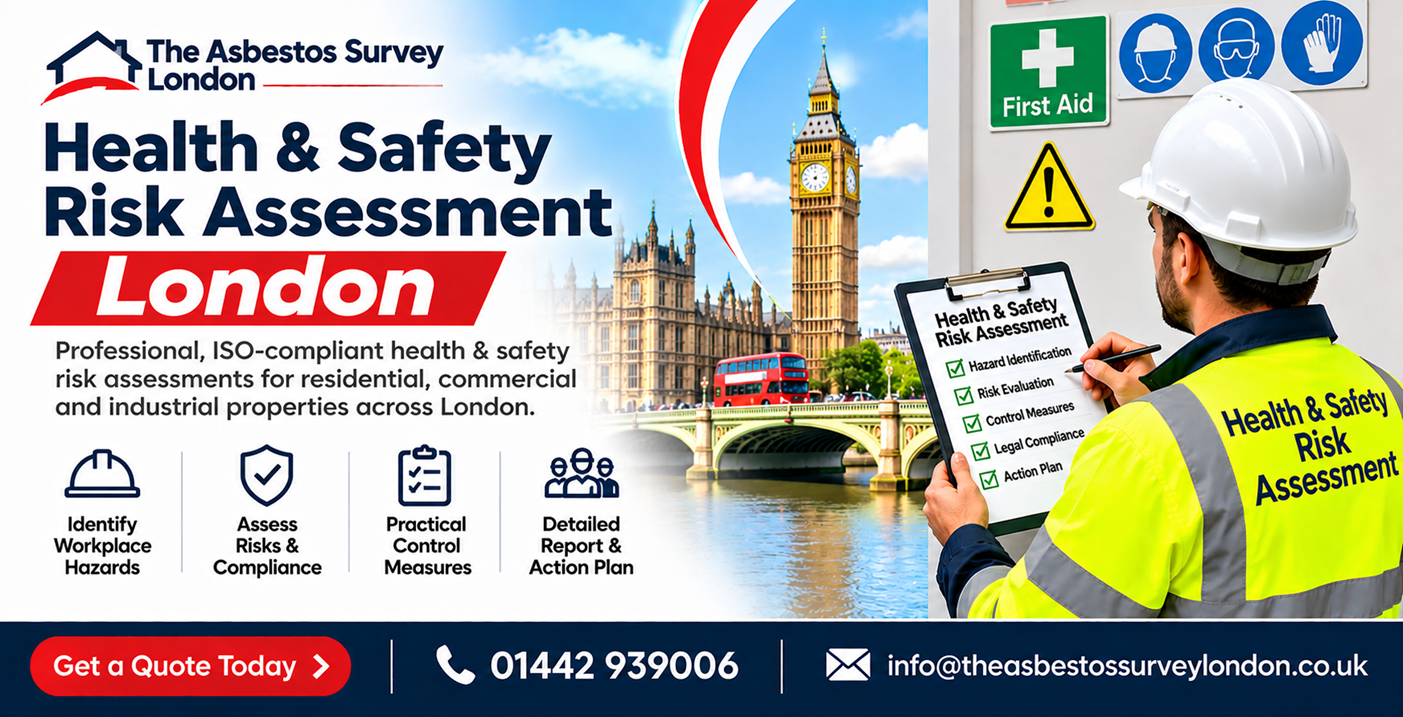
Every employer in the UK has a legal duty to assess the risks in their workplace, whatever the size of the business. If you run a business, manage property or employ staff, a health and safety risk assessment in London or the Home Counties shows you where the dangers are and what to do about them. We carry out practical, plain-English risk assessments for offices, shops, restaurants, warehouses, landlords and community buildings. You’ll get a clear written report and an action plan you can actually follow.
In almost every case, yes. The Health and Safety at Work etc. Act 1974 requires employers to protect the health, safety and welfare of their staff and anyone else affected by their work. In addition, Regulation 3 of the Management of Health and Safety at Work Regulations 1999 says you must carry out a “suitable and sufficient” risk assessment.
If you employ five or more people, you must also record the significant findings in writing. Smaller employers still need to assess the risks, but many choose to write them down anyway, because it’s the easiest way to show what they’ve done.
The duty also applies to:
Above all, a good risk assessment protects your people. However, it also protects your business. Without one, you’re exposed if someone gets hurt, because you can’t show that you took reasonable steps to prevent it.
The Health and Safety Executive and local councils can also issue improvement or prohibition notices, and courts can impose heavy fines. Insurers, landlords and larger clients often ask to see your risk assessments too, especially before you start a contract. So having them ready can help you win work, rather than just keep you out of trouble.
We follow the HSE’s approach to managing risk, which breaks the process into five clear steps.
Firstly, we walk through your premises and look for anything that could cause harm. That includes routine work as well as tasks people forget about, such as cleaning, maintenance and deliveries. We also check your accident and near-miss records, since they often reveal problems that aren’t obvious on a walk-round.
Secondly, we consider everyone your work could affect, including staff, visitors, contractors and members of the public. We pay particular attention to people at higher risk, such as young workers, new and expectant mothers, lone workers and anyone with a disability.
Then we look at how likely harm is and how serious it could be. Next to each hazard, we note the controls you already have and whether they’re enough. Where they aren’t, we recommend practical improvements, starting with removing the hazard altogether if that’s possible.
After the visit, we write everything up in a clear report. It also lists each hazard, who it affects, the controls in place and the actions still needed, together with a risk rating for each one.
Finally, we set a sensible review date. We also explain when you’ll need to review it sooner, for example after an accident or a change to your workplace.
Depending on your business, we can cover:
If you’re not sure which ones apply to you, just tell us about your business. We’ll then recommend the assessments you actually need.
Landlords and managing agents often focus on fire and gas safety, but communal areas carry other risks too. For example, poor lighting, uneven floors, loose handrails, unsafe bin stores and roof access can all cause serious injuries.
A health and safety risk assessment of your common parts identifies these hazards and then gives you a simple plan to fix them. Many landlords combine it with a fire risk assessment, an asbestos management survey and a Legionella risk assessment. Together, these cover the main compliance duties for most residential blocks.
Every assessment includes:
We also write everything in plain English, so you and your staff can easily understand it.
The law doesn’t set a fixed interval. However, you must keep your risk assessment up to date, and most businesses review it at least once a year.
You should also review it whenever something changes. That includes new equipment, new processes, new staff, a move to new premises, or after an accident or near miss. If workers raise a concern, that’s another good reason to look again.
Generally, our risk assessments start from [£X] + VAT for a small business. The final price depends on the size of your premises, the type of work you do and how many specific assessments you need. Either way, we’ll agree a fixed price with you before we visit.
We carry out health and safety risk assessments across London and the Home Counties, including Hemel Hempstead, Watford, St Albans, Harrow, Luton, Aylesbury and Milton Keynes. We also cover every London borough.
Alongside health and safety risk assessments, we also offer asbestos surveys, fire risk assessments, Legionella risk assessments and Energy Performance Certificates. Booking several together often saves time, because we can usually cover them in one visit.
Yes. Every employer must assess the risks to their staff and others affected by their work. If you employ five or more people, you must also record the significant findings.
A health and safety risk assessment covers general workplace hazards, such as slips, trips, lifting and chemicals. A fire risk assessment, on the other hand, focuses only on the risk of fire and how people would escape. Most businesses need both.
Generally, a small office or shop takes a few hours on site. Larger or more complex workplaces can take longer. Your report then follows within a few working days.
Yes, if you understand your workplace and the risks involved. The HSE also publishes free guidance to help. However, many businesses prefer a qualified assessor, because an independent view often spots hazards that people working there have stopped noticing.
Call 01442 939006 or 07860 540077, email info@theasbestossurveylondon.co.uk, or send us a message. We’ll then reply quickly with a free, fixed quote.