
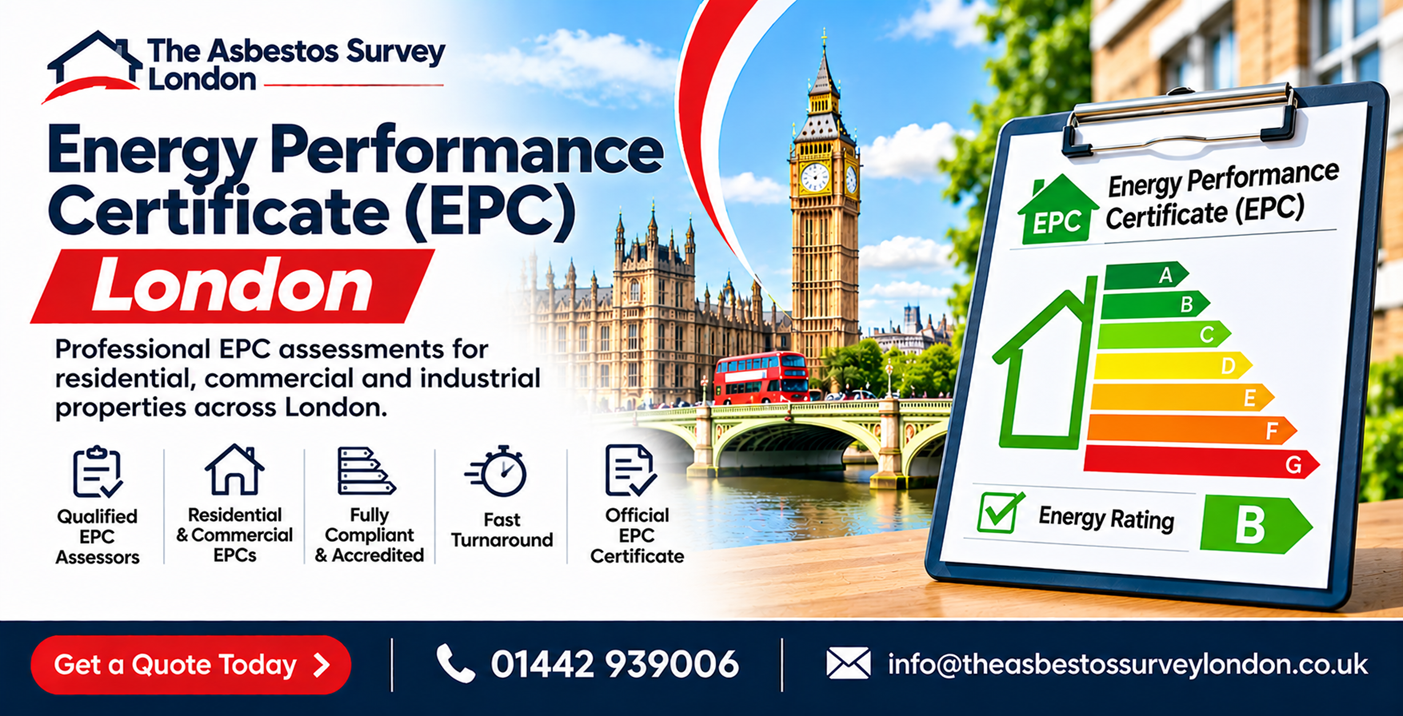
Selling, letting or marketing a property? You’ll almost certainly need an Energy Performance Certificate. We provide every EPC in London, Hertfordshire, Bedfordshire and Buckinghamshire with a quick, reliable service and a fair, fixed price. Our accredited energy assessor visits the property, records the details that affect its energy use and lodges your certificate on the government register. We work with homeowners, landlords, letting agents, estate agents and commercial property owners.
An Energy Performance Certificate shows how energy efficient a building is. It rates the property on a scale from A, the most efficient, to G, the least efficient. It also estimates running costs and lists recommendations that could improve the rating, such as better insulation or a more efficient heating system.
Each certificate stays valid for 10 years. So if your property already has one, you may not need a new one. You can check for free on the government’s EPC register by entering the postcode. If there’s no valid certificate, we can arrange a new EPC in London or the surrounding counties within a few days.
In England, you need a valid EPC whenever you sell or rent out a property. That applies to houses, flats and most commercial buildings. The Planning Portal also explains when you need an EPC in more detail.
Before you put your home on the market, you should have an EPC ready. Many sellers book their EPC in London at the same time as their estate agent’s valuation, so nothing holds up the listing. Estate agents need to show the rating in their adverts, and buyers will see the full certificate before they commit.
Landlords must give tenants a copy of the EPC at the start of every new tenancy. Without a valid certificate, you could face a fine. Furthermore, you can’t legally let a property that falls below the minimum rating, which we explain below.
When a building work project creates a new home or changes how a building is used, it usually needs a new EPC. For example, that includes converting a house into flats or turning an office into homes.
Offices, shops, warehouses and other commercial buildings also need an EPC when they’re sold or let. However, commercial EPCs follow a different method, and the assessor must hold the right level of accreditation for the building.
At present, most privately rented homes and commercial properties in England and Wales must have an EPC rating of at least E. Landlords can’t grant a new tenancy, or continue an existing one, on a property rated F or G unless a valid exemption applies.
Those standards are about to get much tougher. The government has announced that privately rented homes will need to reach at least band C by October 2030. Landlords will have to carry out improvements up to a spending cap, although the government is still finalising some details. Commercial landlords also face proposals for higher minimum ratings in future.
Many older homes, especially Victorian and Edwardian terraces with solid walls, will find band C a challenge. If your property has a rating of D or below, it’s worth planning ahead now, rather than waiting for the deadline. An up-to-date EPC is the first step, because it shows you exactly which improvements would make the biggest difference.
EPCs themselves are also changing. The government is introducing a new style of domestic EPC that shows several separate ratings, rather than one headline figure. These cover areas such as the fabric of the building, the heating system, running costs and how “smart-ready” the home is.
Certificates will still last 10 years. In addition, the reforms will bring more properties into scope, including short-term lets and single rooms in HMOs. We keep up to date with every change, so we can tell you exactly what applies to your property.
An EPC visit is quick and non-intrusive. Our assessor walks through the property and records the features that affect energy use, including:
They’ll also take photos and measurements as evidence. Most flats and houses take between 30 minutes and an hour.
To get the most accurate rating, it helps to have any paperwork ready. For instance, that includes cavity wall insulation guarantees, boiler documents, window certificates and details of any loft insulation. Without evidence, the assessor sometimes has to make cautious assumptions, which can lower your rating.
Every EPC comes with recommendations tailored to the property. Common improvements include:
Some of these cost very little, while others need more investment. The Energy Saving Trust has helpful advice on improving energy efficiency for landlords. If you’re planning bigger works, we’re also happy to talk you through which measures would make the biggest difference to your rating.
Our domestic EPCs in London and the Home Counties start from 75 + VAT for a small flat. The price depends on the size and type of property, while we quote commercial EPCs individually. Either way, we’ll confirm a fixed price before we visit.
We cover London and three neighbouring counties, so wherever your property is, we can usually visit within a few days.
If your town isn’t listed, just ask. We regularly travel across all four areas, so an EPC in London or the Home Counties is rarely more than a short drive away.
Landlords often book several services together, because we can usually complete them in one visit. Alongside EPCs, we also offer asbestos surveys, asbestos management surveys, fire risk assessments, Legionella risk assessments and health and safety risk assessments.
If you’re improving a pre-2000 property to raise its EPC rating, you may also need an asbestos refurbishment survey before work starts. That’s especially true for jobs like loft insulation, boiler replacement and new windows, which can disturb older materials.
An EPC stays valid for 10 years. However, if you’ve made major improvements, a new certificate could show a better rating.
Most flats and houses take between 30 minutes and an hour on site. Larger homes and commercial buildings take longer.
Not usually. Most rented properties must have a rating of at least E, unless the landlord has registered a valid exemption. Stricter standards are also on the way.
Yes. As well as providing EPCs in London, we cover the whole of Hertfordshire, Bedfordshire and Buckinghamshire, including Hemel Hempstead, Watford, Luton, Aylesbury and Milton Keynes.
Not necessarily. Someone just needs to give the assessor access to every room and the loft. A letting agent, tenant or key holder can do this for you.
Call 01442 939006 or 07860 540077, email info@theasbestossurveylondon.co.uk, or send us a message. We’ll then reply quickly with a fixed price.