
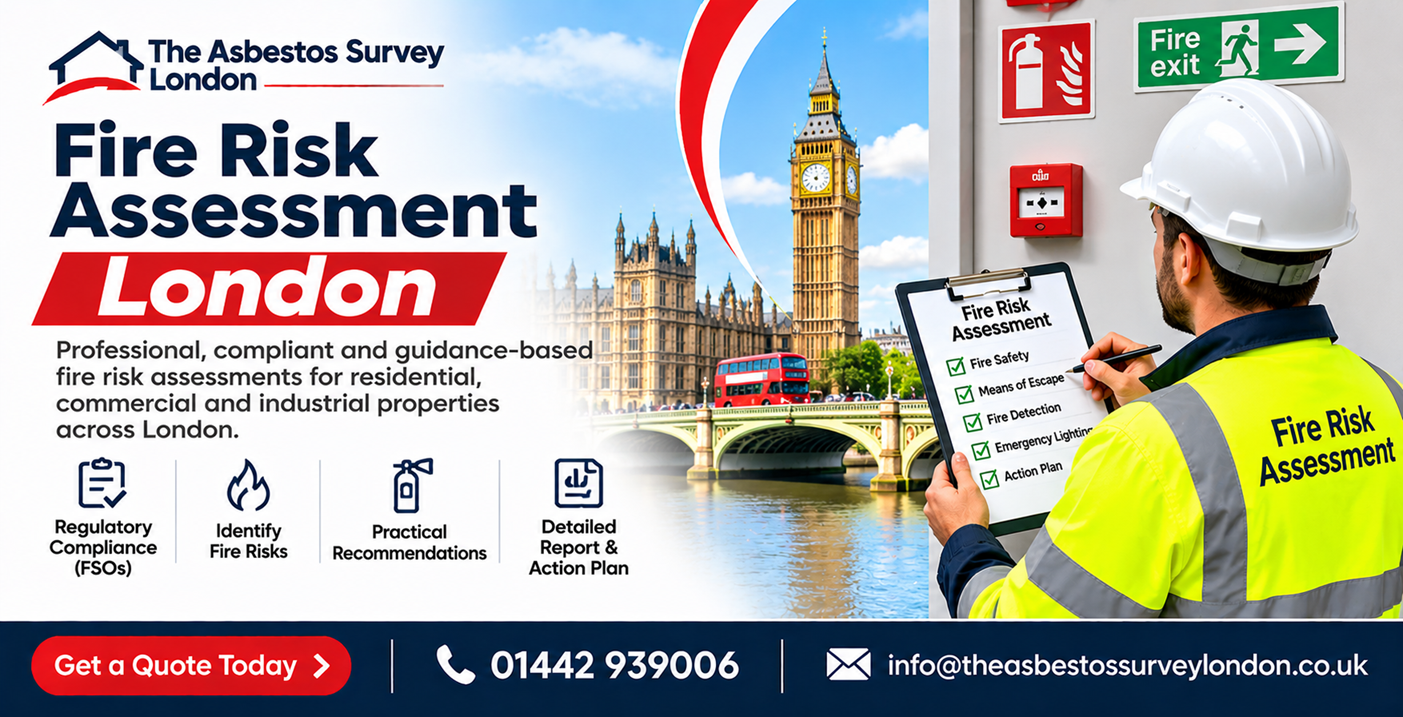
If you’re responsible for a business, a block of flats, an HMO or any other non-domestic building, the law says you must have a fire risk assessment. We provide fire risk assessment in London, Hertfordshire, Bedfordshire and Buckinghamshire for landlords, managing agents, businesses and community organisations. Each assessment follows the PAS 79 methodology, and you’ll get a clear written report with a practical action plan. That way, you’ll know exactly where you stand and what to fix first.
Under the Regulatory Reform (Fire Safety) Order 2005, almost every non-domestic building in England needs a fire risk assessment. The person in control of the premises, known as the “responsible person”, must make sure someone carries one out and keeps it up to date.
In practice, that usually means:
Private single-family homes generally don’t need one. However, if a building contains two or more flats, the communal areas do. Since the Fire Safety Act 2021, the assessment must also cover the building’s structure, external walls and the entrance doors to each flat.
Fire safety law has also changed a great deal in recent years. As a result, many older assessments no longer meet the current rules.
Since 1 October 2023, Section 156 of the Building Safety Act 2022 has required every responsible person to record their full fire risk assessment in writing. Previously, smaller businesses only had to write down the significant findings. You must now also record the name of the person who carried out the assessment and, where relevant, their organisation.
In buildings with two or more flats, you must also share key fire safety information with residents. That includes the risks the assessment found, the safety measures in place and the name and UK address of the responsible person.
The Fire Safety (England) Regulations 2022 added further duties for blocks of flats. The London Fire Brigade also has a useful summary of these duties. For example, every multi-occupied residential building must give residents fire safety instructions and information about fire doors. In buildings over 11 metres tall, you must also check communal fire doors every three months and flat entrance doors every year.
Furthermore, the penalties for getting this wrong are serious. Fire and rescue authorities can issue enforcement notices, and courts can impose unlimited fines. In the worst cases, responsible persons can even face prison.
Every assessment we carry out follows PAS 79, the industry’s recognised methodology. PAS 79-1 covers non-housing premises, while PAS 79-2 covers housing such as flats and HMOs. During the visit, we look at five main areas.
Firstly, we identify anything that could start a fire. That includes electrical installations, heating, cooking, smoking, rubbish storage and the risk of arson.
Secondly, we consider who could be in danger, including residents, staff, visitors and contractors. We pay particular attention to anyone who might struggle to escape, such as elderly or disabled people, children and lone workers.
Then we check the measures that protect people. That includes fire doors, compartmentation, escape routes, emergency lighting, fire alarms, signage and firefighting equipment.
We also review how you manage fire safety day to day. For instance, we look at testing and maintenance records, staff training, fire drills and housekeeping.
Finally, we rate the overall risk and give you a prioritised list of actions. Each item has a clear explanation, so you can act on the most urgent issues first.
Flats have their own guidance and their own types of assessment. Generally, most blocks need a Type 1 assessment, which covers the common parts and doesn’t involve opening up the building. However, if there are concerns about the structure or compartmentation, you may need a more intrusive Type 2, 3 or 4 assessment.
We’ll recommend the type your building actually needs. In addition, we can help you prepare the resident information that the new regulations require.
Houses in multiple occupation carry a higher fire risk, because several unrelated people share kitchens, escape routes and electrical supplies. Many councils also ask to see a current fire risk assessment when you apply for or renew an HMO licence.
We check that your fire doors, alarm system, emergency lighting and escape routes meet the standard expected for the size and layout of your property. Then we’ll explain clearly what, if anything, you need to change.
For offices, shops, restaurants, warehouses and industrial units, we especially look at the fire risk from your processes, layout and staffing. We also check that your staff know what to do in an emergency, and that your evacuation plan works in practice. Once we’ve finished, you’ll have a written record that meets your legal duty as an employer. The government’s guide to fire safety in the workplace explains these duties in more detail.
The law also says you must review your assessment regularly and keep it up to date. Most responsible persons review it at least once a year, which is common practice for higher-risk premises such as flats and HMOs.
You should also review it whenever something changes. For example, that includes building work, a change of use, new tenants or a fire or near miss.
Our fire risk assessments start from [£X] + VAT for a small property. The final price depends on the type and size of the building, the number of floors and the type of assessment needed. Larger blocks and complex commercial premises therefore cost more. In every case, though, we’ll agree a fixed price with you before we visit.
We carry out fire risk assessments across London and the Home Counties. That includes Hemel Hempstead, Watford, St Albans, Harrow, Luton, Aylesbury and Milton Keynes. We also cover every London borough.
Alongside fire risk assessments, we also offer asbestos surveys, asbestos management surveys, Legionella risk assessments and Energy Performance Certificates. If you’re planning building work as a result of your assessment, you may also need an asbestos refurbishment survey first, because fire-stopping and door replacements often disturb older materials. Landlords and managing agents often book these together, because we can usually complete them in one visit. For local asbestos surveys, see our pages for Hemel Hempstead, Watford, Harrow, Luton, Aylesbury and Milton Keynes.
Yes, for almost all non-domestic premises, including the common parts of flats and HMOs. The responsible person must make sure someone carries it out and keeps it up to date.
A small shop, office or block of flats usually takes a few hours on site. Larger or more complex buildings can take longer. Your report then follows within a few working days.
The law allows it, but only if you’re competent to do so. The government also publishes guides for responsible persons if you want to understand the basics. For anything beyond a very simple premises, most people choose a qualified assessor, because a poor assessment leaves you exposed.
You’ll receive an action plan. Some items may be quick fixes, while others need a contractor. Either way, we’ll explain what each one means and how urgent it is.
Call 01442 939006 or 07860 540077, email info@theasbestossurveylondon.co.uk, or send us a message. We’ll then reply quickly with a free, fixed quote.